
How a solar power system works
How it works
How does a solar power system work?
A solar power system converts the radiant energy of sunlight into usable electricity. The solar modules on the roof capture the sun's rays with the help of solar cells and thus produce direct current (DC). This DC is then converted into alternating current (AC), i.e., electrical current, by an inverter. Solar power is therefore electricity generated by the photovoltaic effect in solar cells. No exhaust emissions are produced during electricity generation.
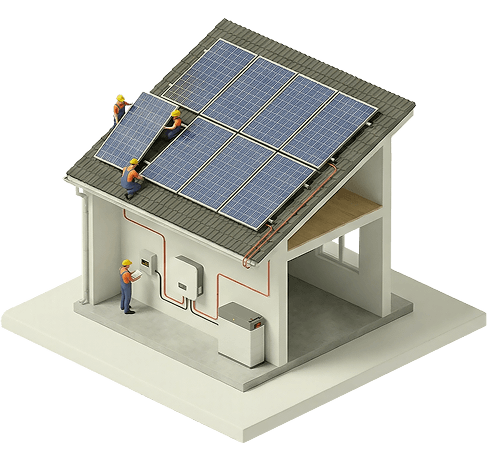
The following graphic shows how a solar system works, including the positioning of the most important elements in the house:
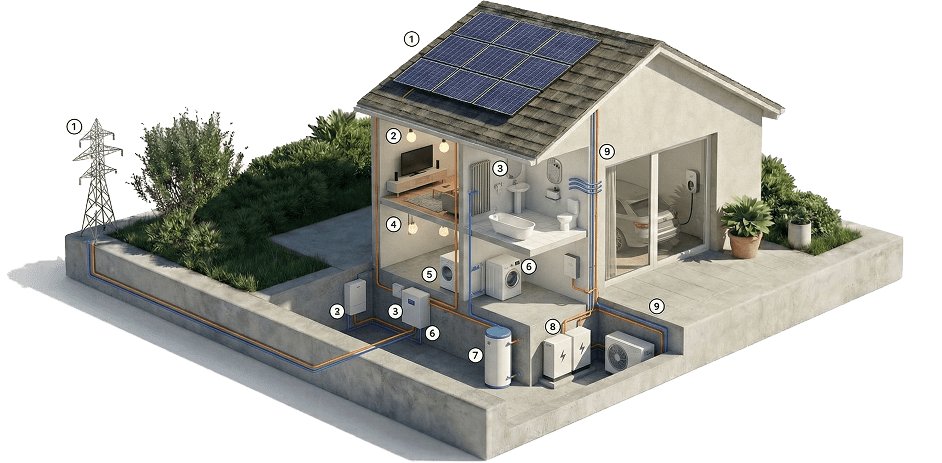
How a solar panel works
Solar panels can convert sunlight into electricity. This is made possible by semiconductors (silicon), which conduct electricity. As soon as sunlight shines on the solar panel, electrons are excited. The electrons then move through the layers of the solar panel to the inverter. The electrons transport the electricity to where the energy is needed. Depending on demand, the energy goes directly to the end users (light bulb, PC, battery, etc.), where the electricity is available for later use.
Solar modules – also called solar panels – consist of many small solar cells. When many solar modules are connected together, it is called a solar power system.
Construction of the photovoltaic system
Learn More
Solar Panels
You bear no financial risk – we cover all costs for the planning, installation, and maintenance of your solar system.
Inverter
You bear no financial risk – we cover all costs for the planning, installation, and maintenance of your solar system.
Electricity Meter
You bear no financial risk – we cover all costs for the planning, installation, and maintenance of your solar system.
Which solar system is right for me?
When choosing the right solar system, you should consider not only your energy consumption but also the size and current characteristics of your roof. You can also choose between a roof-mounted or roof-integrated system, as well as various solar panel colors.
Household consumption
First, you need to determine your household's annual electricity consumption. The solar system should at least cover the household's electricity consumption.
Size of the roof area
The roof area determines how many solar panels, and therefore the maximum power output, can be installed. The panels must be arranged in such a way that they cover your household's electricity consumption.
Required photovoltaic system output per household
The electrical output of a photovoltaic system is measured in kWp (kilowatt peak). In Switzerland, depending on location and efficiency, an average of 800-1,300 kilowatt-hours (kWh) can be generated per kWp per year. The following table shows the average required output for different household sizes and the resulting size of the solar system.
Get a free, no-obligation quote now!
Further selection criteria
"Generally, we recommend aligning the size of the PV system with your consumption or choosing a larger system."
A solar power system has a lifespan of 30 years, meaning the roof should be designed to last at least that long. If the roof is already porous or older than 40 years, an integrated roof system is a good option.
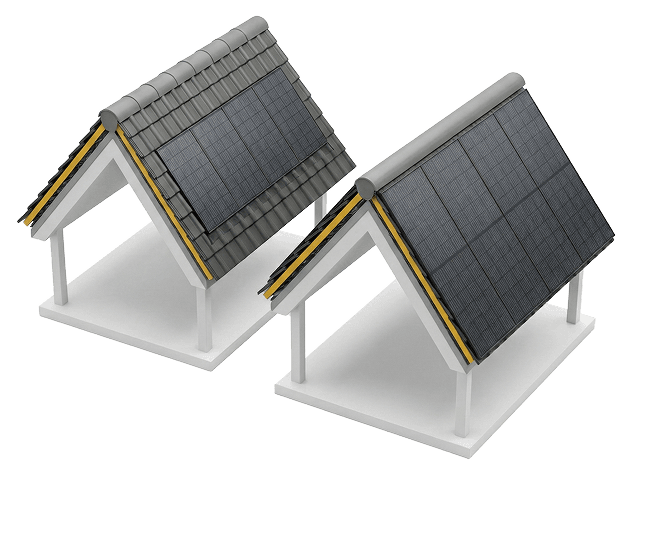
In Switzerland, rooftop solar systems are the most popular. The solar modules are mounted on a substructure, leaving the original roof intact. Rooftop systems are cost-effective and can be installed very quickly. With an integrated roof system, the photovoltaic system replaces the roof covering. This option can therefore be considered for older roofs that need renovation or for new construction. The solar modules are available in various colors. Color coordination can create a particularly elegant look. Integrated roof systems are approximately 20 percent more expensive than on-roof systems. However, no roof covering is required.
FreeState offers solar modules in classic silver-grey, anthracite and, upon request, in other color shades.
Installation of a solar system
The installation costs are fully included in the price of the solar system.
We install the system with our team of experienced professionals: electricians, roofers, carpenters, plumbers, and sheet metal workers. Depending on the size of the solar system, installation takes between 2 days and one week.
Maintenance of a solar system
We ensure the highest quality in component selection and installation. Our photovoltaic systems have an average lifespan of 30 years and require very little maintenance. You receive a 20-25 year warranty from the module manufacturer. Only the inverter needs to be replaced every 12 years. Optionally, you can take out a monitoring contract with FreeState to ensure you are covered for the entire 30-year lifespan of your system. Furthermore, we guarantee the energy yield for the first 10 years, thus securing the long-term operation of your PV system (see our terms and conditions for full details).
At FreeState, you get a top-quality photovoltaic system at affordable prices. Starting from just CHF 10,000, including subsidies and tax savings, you can become your own electricity producer and thus independent of rising electricity costs. And last but not least: you'll be making a positive contribution to the environment.