Guide
Solar systems in Switzerland: planning, costs, subsidies and yield
A photovoltaic system on your own roof produces electricity for 25 to 30 years. Here you will find what counts before you decide: how large the system should be, what it costs, what subsidies there are and how you can pay for it.
Is my roof suitable?
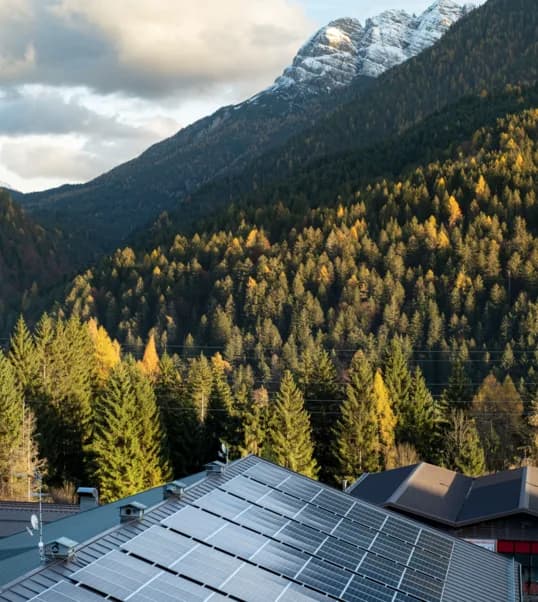
Almost any roof without heavy shading is suitable. A south-facing surface produces the most, but east-west roofs spread the power more evenly across the day and so often match your own consumption better. Each kilowatt peak of output needs around 5 m² of roof area.
In Switzerland, a system with 8 kWp typically produces 7'000 to 9'000 kWh a year. Our solar calculator shows what your roof can deliver, using data from Sonnendach, the federal solar cadastre.
How large should the system be?
In the past, a system was sized for current consumption. That is outdated, because a heat pump and an electric car increase electricity demand, and the fixed costs for scaffolding, planning and connection arise at any size. In most cases, it pays to make good use of the roof.
We size the system based on your consumption, the loads you plan to add and your grid operator's feed-in tariff.
What does a solar system cost?
The price per kilowatt peak falls as the system gets larger. The roof, scaffolding, electrical installation and choice of inverter affect it, as does the question of whether a battery is added. You will find current prices per kWp and worked examples for 6, 10 and 15 kWp on our cost page.
When the system has paid for itself depends above all on the share of the electricity you use yourself. Every kilowatt hour you use yourself replaces electricity at the grid tariff, while every kilowatt hour you feed in earns only the feed-in payment.
Subsidies, feed-in payment and taxes
The federal government supports solar systems with a one-off subsidy (Einmalvergütung), which is paid out through Pronovo. Depending on the location, there are also contributions from the canton and the municipality. For existing buildings, the investment can be deducted from taxes as property maintenance in almost all cantons.
You receive a feed-in payment from the grid operator for the electricity you feed into the grid. Since 2026, a minimum feed-in payment of 6 Rappen per kilowatt hour has applied to systems of up to 30 kW. Because grid electricity costs several times as much, self-consumption is the most important lever for profitability.
Buying, paying by subscription or no investment of your own
At Free State you choose between three models. With SolarDirect you buy the system and own it from the start. With SolarAbo you pay in fixed monthly instalments, and monitoring, warranty and insurance are included. With SolarFree you get your solar system without any investment of your own and can buy it later.
Permit and process
In Switzerland, sufficiently adapted solar systems on roofs in building and agricultural zones do not need a building permit. A notification to the municipality is enough. Exceptions apply to cultural and natural monuments and in some core zones.
We handle the notification, the connection application to the grid operator and the subsidy application. After installation, an independent inspection body approves the system, and then it is connected to the grid.
Battery storage, heat pump and charging station
A solar system becomes more economical the more electricity stays in the house. A battery shifts midday power to the evening, a heat pump turns it into heat, and a charging station puts it into your electric car. If you think these steps through from the start, you save yourself later changes to the electrical installation.